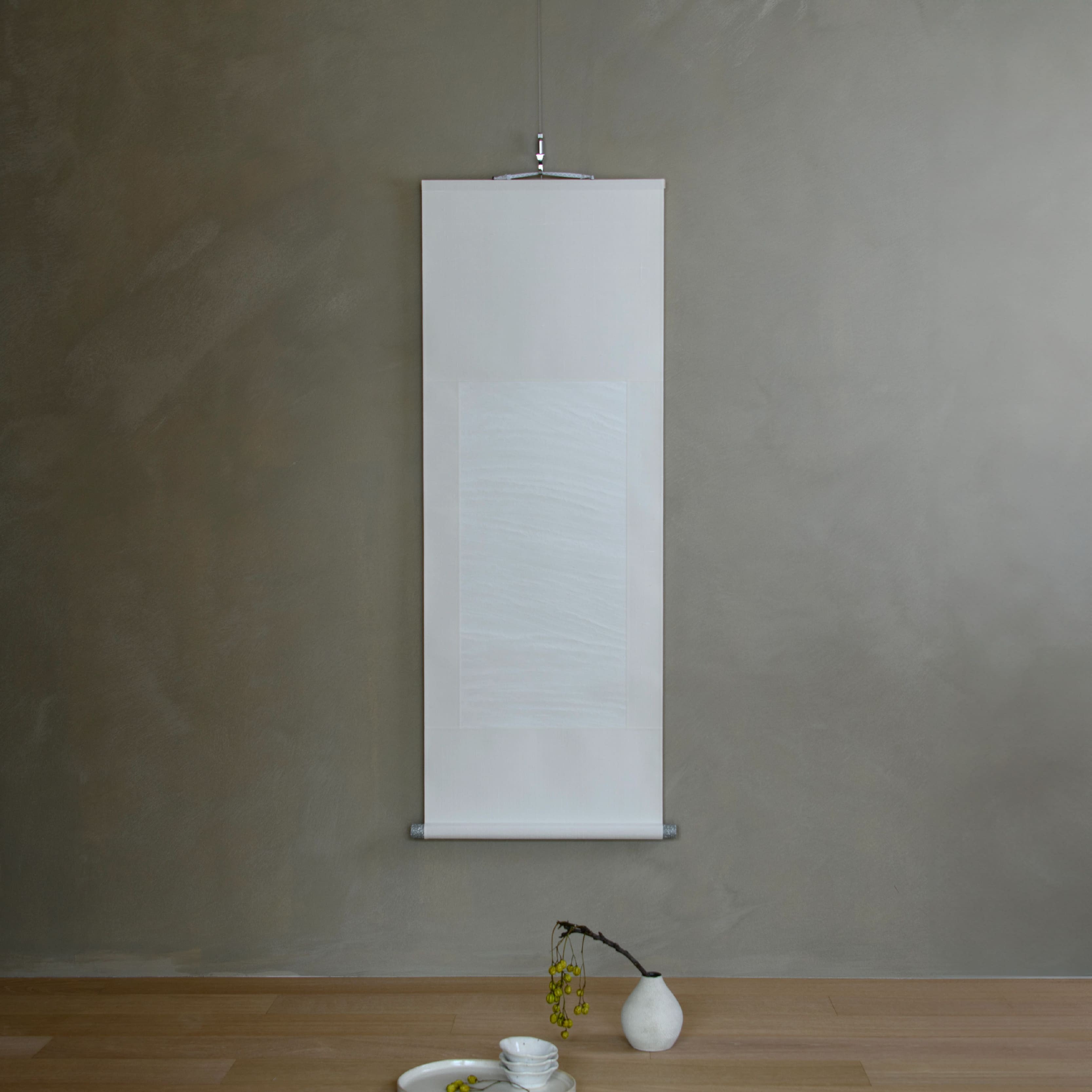
A kakejiku — a Japanese hanging scroll — does not need a traditional Japanese room. JIQUU is a scroll designed to be hung as wall art in any interior: about 45 cm wide and 110 cm tall, weighing only about 200 g, and made entirely in Fukui Prefecture from Echizen washi, a handmade Japanese paper with a history of some 1,500 years. Its theme is time, expressed in three works: past, present and future.
This guide explains the idea behind JIQUU, the five Fukui workshops that make each scroll, how the three works differ, how to hang a scroll in a modern room, and how to order from outside Japan.
What is a kakejiku, and what makes JIQUU different?
According to the product description, kakejiku have been hung since the Heian period in the tokonoma (a decorative alcove in a Japanese room) or on walls, and changed to suit the season or occasion. As Japanese homes have become more Western in style, rooms with a tokonoma have become rare, and hanging scrolls have drifted away from everyday life.
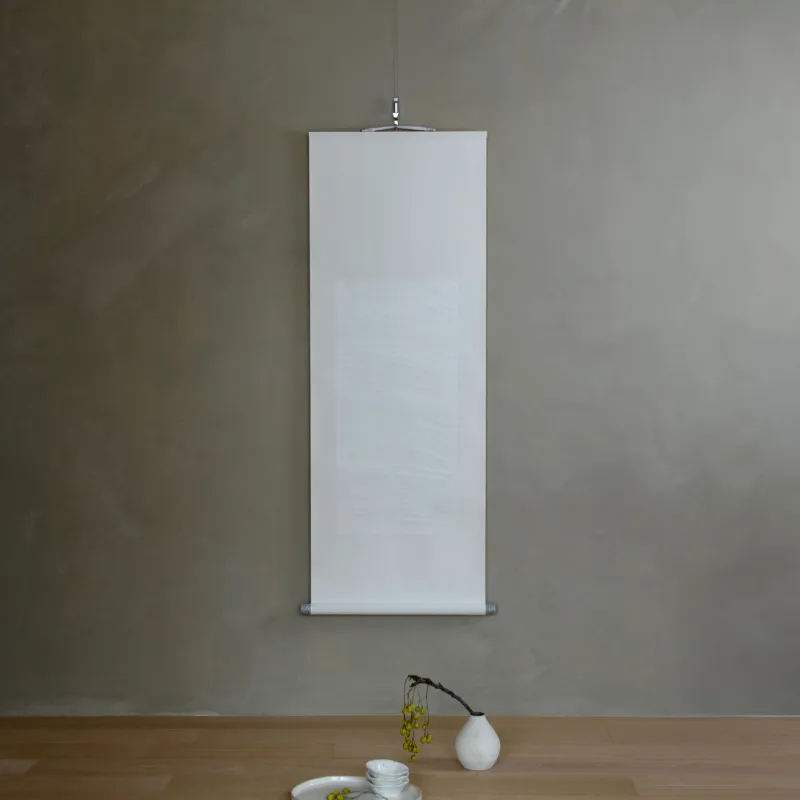
JIQUU — the name is pronounced “jikū” — is described as a new style of kakejiku that creates atmosphere regardless of time or place. It is meant to be displayed as interior decoration or wall art in any season, room or setting. It is sold by 株式会社山岸和紙店, a company that deals in Echizen washi. The company describes Echizen City in Fukui as the only place in the world where a god of paper is enshrined.
ALL FUKUI MADE: five workshops in one scroll
Every part of JIQUU — not only the paper but also the mounting fabric, roller ends, braided cord and mounting work — is made in Fukui Prefecture, under the label “ALL FUKUI MADE.” Workshop names are given in Japanese as they appear on the product page.
| Part | Workshop | What it is |
|---|---|---|
| Washi paper | 滝製紙所 | The central paper panel |
| Mounting fabric (kireji) | 衣目織物 | The cloth framing the paper |
| Roller ends (jikusaki) | 丸廣意匠 | The end pieces on the bottom rod |
| Braided cord (kumihimo) | 多田製紐 | The cord for hanging and tying the rolled scroll |
| Mounting (hyōgu) | 丸山表具店 | Assembling paper and cloth into a scroll |
Materials: washi made from kōzo (paper mulberry fiber), silk, cherry wood and polyester. Because the central panel is handmade washi, every scroll looks slightly different.
Past, present and future: the three works
All three share the same size, materials and price; choose by the room you have in mind and the meaning you want.
- KASANARI -past-: “History and experience pile up like layers of earth, and so the present exists.” A scroll for cherishing how things came to be, intended to stand quietly in a special place and offer support. Suited to a study or bedroom.
- MAJIWARI -present-: “Amid changing times, past and future always meet — that is the present.” Intended to brighten a lively space where family and friends gather, such as a living or dining room.
- HAJIMARI -future-: the work that represents the future. Its name means “beginning,” which makes it a thoughtful choice for someone starting life in a new home.
Hanging a kakejiku in a modern room
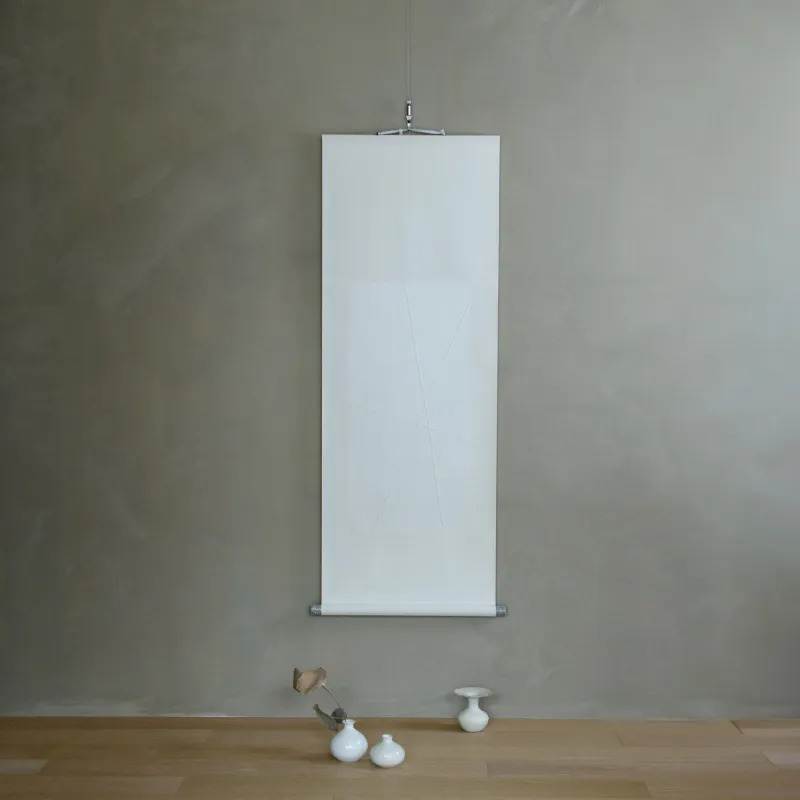
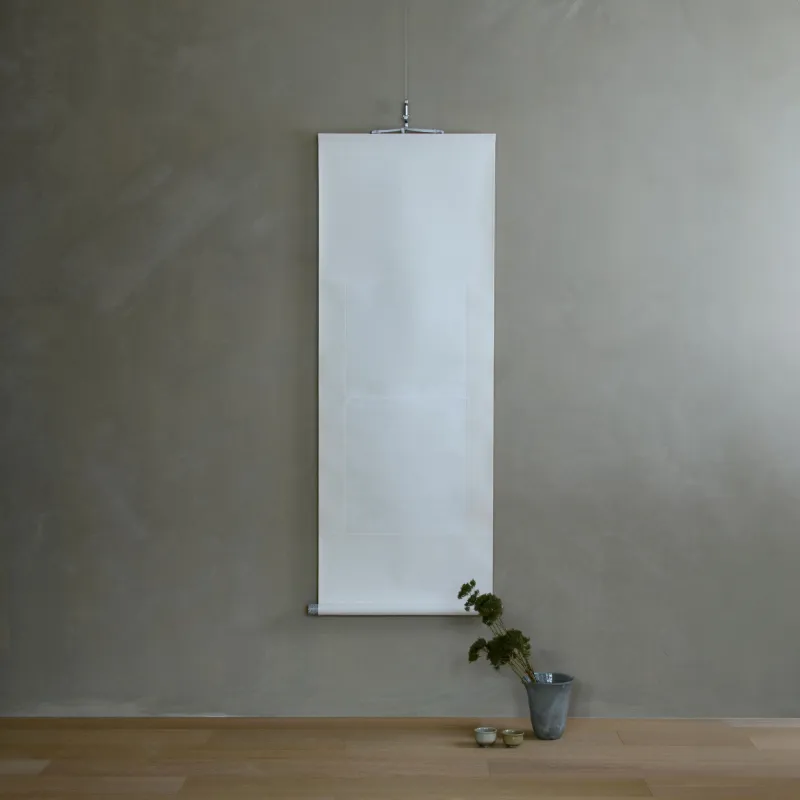
JIQUU measures 450 mm wide × 25 mm deep × 1,100 mm tall (about 17.7 × 1 × 43.3 in), and the scroll itself weighs about 200 g (about 7 oz). Its tall, narrow shape suits a wall with vertical space.
General guidelines for hanging scrolls:
- Avoid direct sunlight, humidity and air blowing straight from an air conditioner.
- Hang it so the center sits around or slightly above eye level.
- When storing, roll it up and keep it in its box in a dry place.
The product page notes that, because of the nature of the materials, the scroll may discolor or otherwise change over time depending on the environment. Hanging hardware is not mentioned, so check the product page or ask the maker before ordering.
Giving JIQUU as a gift
A scroll that suits rooms without a tokonoma makes a considered gift for a new home, a new business or a retirement.
- Price: ¥110,000 for each work (Japanese yen, tax included, as of October 2026)
- Lead time: 1 to 2 months, so order well ahead of the date
- Box: the product page lists the weight as about 200 g for the scroll and about 600 g for the paulownia box (including a paper box)
- Each one differs: the handmade washi means no two scrolls look exactly the same
Buying from outside Japan
ITOSHIO does not ship directly to addresses outside Japan. International orders go through Buyee, a proxy shopping service: open the product page and use the Buyee button on the page. International shipping, Buyee's fees and any duties are shown on Buyee's screens, and you should check Buyee's guidance for the countries it ships to and any item restrictions. If you have a delivery address in Japan, choose “I have a delivery address in Japan” on the product page.
The amount shown on Buyee will differ from the yen price because of exchange rates and fees. Allow for the 1 to 2 month lead time before the scroll is sent. Step-by-step instructions: how to buy from overseas with Buyee. Buyee's site: https://buyee.jp/
Products in this article
| Work | Theme | Size | Lead time | Price (JPY, tax incl., Oct 2026) |
|---|---|---|---|---|
| JIQUU KASANARI -Past- | Past | 450 × 25 × 1,100 mm | 1–2 months | ¥110,000 |
| JIQUU MAJIWARI -Present- | Present | 450 × 25 × 1,100 mm | 1–2 months | ¥110,000 |
| JIQUU HAJIMARI -Future- | Future | 450 × 25 × 1,100 mm | 1–2 months | ¥110,000 |