An ohitsu is a wooden container that you move freshly cooked rice into. The wood absorbs the excess steam, so the rice does not turn soggy, and it stays soft enough to shape into onigiri (rice balls) even after it has cooled. It is not a rice warmer: think of it as a tool that looks after the texture of the rice rather than its temperature.
This guide explains what an ohitsu does, where the magewappa bentwood technique comes from, how to choose a size using the Japanese rice measure "gō", and how to use and care for one. The example throughout is the 2-gō ohitsu made by 栗久, a magewappa maker in Odate, Akita Prefecture.
What an ohitsu does
Before electric rice cookers, rice in Japan was cooked in a heavy pot and then moved into a wooden ohitsu to be carried to the table and served. The habit has never quite disappeared. Some households today use an ohitsu alongside a rice cooker: cook the rice as usual, then transfer it to the ohitsu instead of leaving it on the keep-warm setting.
The reason is moisture. Freshly cooked rice releases a lot of steam. In a closed plastic or glass box, that steam condenses into droplets and falls back onto the rice, so the surface turns wet and the grains harden as they cool. In a wooden ohitsu, the wood takes up the excess moisture and the rice keeps a clean, separate texture. Leftovers stay pleasant at room temperature for onigiri or a bento box later in the day.
Magewappa: bentwood from Odate, Akita
Magewappa is a Japanese bentwood technique. Thin sheets of wood, traditionally cedar, are softened with heat and water, bent into a ring, and the seam is stitched with strips of cherry bark. Odate, a city in Akita Prefecture in northern Japan, is a well-known center of the craft, and Odate magewappa holds the Japanese government's Traditional Craft designation.
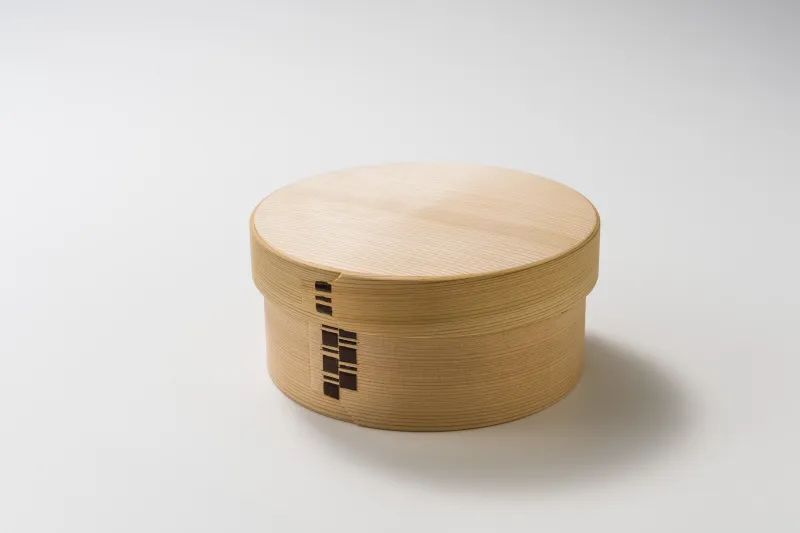
栗久 is a magewappa maker based in Odate. In its own words, it "creates new designs while preserving tradition".
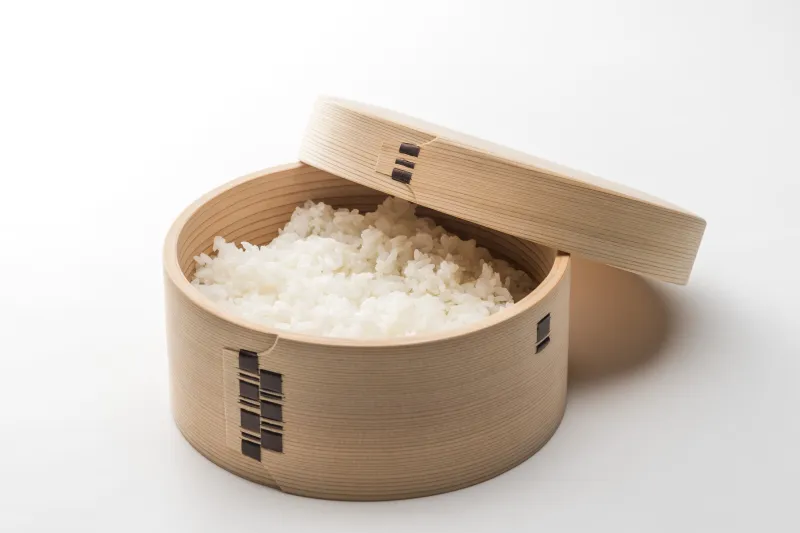
Inside 栗久's 2-gō ohitsu
Two details stand out in 栗久's 2-gō ohitsu.
- A 15 mm thick lid. According to the maker, the thick lid board absorbs the steam rising from hot rice, so it does not turn into droplets, and cooled rice does not harden. The maker notes that the rice stays good for shaping onigiri.
- Rounded inner corners. The corners where the wall meets the base are finished with a curve, so rice is easy to scoop out and does not get stuck in the corners, and the container is easy to wash and quick to dry.
Price: ¥44,000 (Japanese yen, tax included, as of October 2026. The amount shown on Buyee varies with exchange rates and fees.)
What "2-gō" means: choosing a size
Ohitsu sizes are given in gō (合), the traditional Japanese measure for rice. One gō is about 180 ml, and the small measuring cup that comes with a Japanese rice cooker is usually one gō. An ohitsu labeled "2-gō" is generally sized to hold the rice cooked from two gō of uncooked rice.
Choose by how much rice you cook at a time, not by the number of people at the table.
| Uncooked rice | Cooked rice (approx.) | Bowls (approx.) |
|---|---|---|
| 1 gō (about 180 ml) | 330 g | 2 |
| 2 gō (about 360 ml) | 660 g | 4 |
| 3 gō (about 540 ml) | 1 kg | 6 to 7 |
If you usually cook one or two rice-cooker cups at a time, a 2-gō ohitsu is the right size. If you regularly cook three cups or more, a 2-gō ohitsu may be too small.
How to use and care for an ohitsu
Daily use is simple. Always follow the care notes that come with your piece, as preparation can differ by maker and finish.
- Before use, moisten the inside with a little water or wipe it with a well-wrung damp cloth. With bare, unfinished wood, this is generally said to keep rice from sticking.
- As soon as the rice is cooked, transfer it to the ohitsu, loosening it gently with a rice paddle so the excess steam can escape.
- Put the lid on and bring it to the table. Serve straight from the ohitsu.
- Eat what is left the same day, or shape it into onigiri for later.
Microwave, dishwasher and fridge
Wooden tableware is generally not suitable for the microwave or the dishwasher, because heat and fast drying can cause cracks and warping.
Makers give different answers on whether an ohitsu can go in the fridge, and 栗久's product description does not cover it, so follow the notes that come with your piece. For rice you want to keep for several days, freezing it in portions is the usual approach.
Washing and drying
Care comes down to washing it and letting it dry properly. For bare-wood magewappa, the general guidance is:
- Wash with lukewarm water and a soft sponge or brush. Detergent is generally avoided, as the wood can absorb it and hold the smell.
- Do not leave it soaking. Wood that stays in water swells and can crack as it dries.
- Wipe off the water and let it dry fully in a shaded, well-ventilated place. Avoid direct sunlight and the side of the stove, where it dries too fast.
- Do not put it away while it is still damp, which can lead to mold spots.
Reheating with a seiro
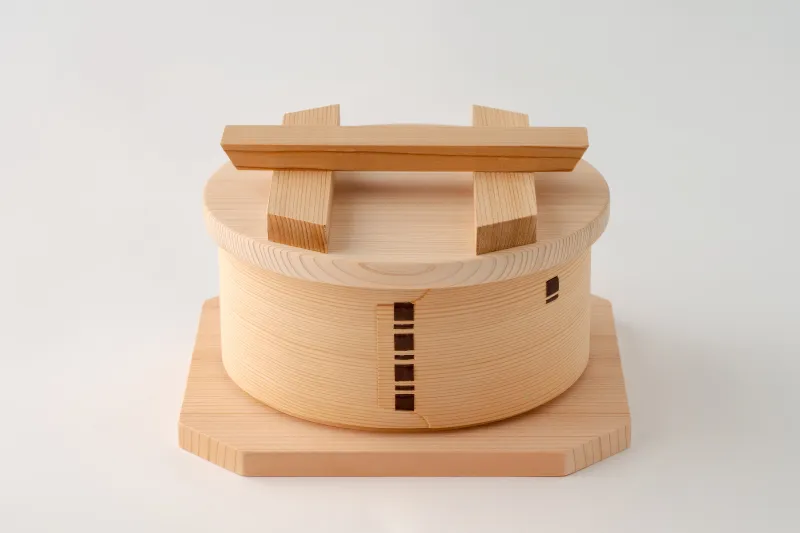
Rice that has cooled in an ohitsu can be steamed back to a soft texture, with no microwave involved. 栗久 also makes a 3-gō seiro (wooden steamer basket) with a perforated board for the steam, so it can be used on pots of different sizes. Price: ¥20,900 (Japanese yen, tax included, as of October 2026. The amount shown on Buyee varies with exchange rates and fees.) The full how-to is in How to use a Japanese steamer basket.
Buying from outside Japan
ITOSHIO does not ship directly to addresses outside Japan. International orders go through Buyee, a proxy shopping service. When you open a product page from abroad, a note titled "Purchasing from Overseas" appears, and you can use the Buyee button on the page to place your order on Buyee. International shipping, Buyee's fees and any duties are shown on Buyee's screens, and the countries and items Buyee can ship are explained in Buyee's own guidance.
If you are sending the ohitsu to someone with an address in Japan, choose "I have a delivery address in Japan" on the product page to order for domestic delivery.
Step-by-step instructions: How to buy from overseas with Buyee. Buyee's website: https://buyee.jp/
Featured in this article
| Item | Price | What it is for | Maker |
|---|---|---|---|
| Ohitsu Rice Container, 2 Go | ¥44,000 | Holding cooked rice. 15 mm lid absorbs steam; rounded inner corners | 栗久 (Odate, Akita) |
| Seiro Steamer, 3 Go | ¥20,900 | Steaming food and reheating rice; perforated board fits different pot sizes | 栗久 (Odate, Akita) |
FAQ
Does an ohitsu keep rice warm?
No. It is not a warmer, so the rice cools over time. What it does is keep the rice from turning soggy or hard as it cools. For warm rice, steam it again before eating.
Is it hard to look after?
Wash it with lukewarm water and dry it well after each use. Soaking and the dishwasher are generally best avoided, but the rounded corners of this ohitsu mean few grains are left behind.
Can it be shipped to my country?
Orders from outside Japan go through Buyee. Whether this item can be sent to your country, and what it costs, is shown on Buyee's screens. See How to buy from overseas with Buyee.